Last Age: Survival
- 3.7
- Rating
- 10.00K
- Installs
- Free
- Price

 Analysis by App-foxy
I approached Last Age: Survival as a quick test of whether a mobile strategy game can make the zombie-apocalypse theme feel like a meaningful planning challenge rather than a collection of familiar survival scenes. Its central idea is easy to understand: establish a stronghold, prepare it for attacks, and make sensible decisions while the world around you becomes increasingly dangerous. That simplicity is useful, but it also means the game has to earn your attention through the quality of its moment-to-moment choices.
After spending time with it, I see a game aimed at players who enjoy building a defensive base and thinking ahead more than players who want a fast action game. It is free to start, developed by HANX GAMES, and listed for a Teen audience. The current version is 1.0.2, with support beginning at Android 7.1, so it is positioned as an accessible option for people using a broad range of Android devices.
What to consider before choosing Last Age: Survival
The first question is not whether you like zombies. It is whether you enjoy the rhythm of preparing, waiting, adjusting, and preparing again. The game’s appeal rests on that cycle. You are not simply reacting to enemies on screen; the fantasy is that your choices before trouble arrives determine how well your fort survives it.
You May Also Like

 AccuWeather: Weather Radar
AccuWeather Review: A Quick, Clear Forecast for Everyday Decisions
For everyday plans, the best forecast is the one you can understand quickly. AccuWeather makes rain timing, radar, and local conditions easy to act on, with a few trade-offs.

 Hill Climb Racing
Why Hill Climb Racing Still Turns Crashes Into One More Run
A tiny car, a bumpy hill and one more upgrade: Hill Climb Racing keeps resurfacing because its simple chaos makes every near-miss feel personal.

 AliExpress - Shopping App
AliExpress Makes Global Shopping Feel Personal, but Shoppers Bear the Risk
AliExpress turns a global marketplace into a pocket-sized discovery engine. Its reach is useful, its shopping loop compelling, and its trade-offs easy to miss.

 Lords Mobile: Kingdom Wars
Lords Mobile Is a Kingdom-Building Routine, Not a Quick Match
A case-by-case verdict on the building, battles, device demands, and social commitments that make Lords Mobile rewarding for some players and exhausting for others.

 PDF Scanner app - TapScanner
TapScanner Makes Paperwork Easier to Capture, Check, and Share
TapScanner makes scanning with a phone feel less like a rescue operation and more like a dependable step in getting work done. Its capture tools are useful, though not flawless.

 Block Blast!
 Shows How Much a Puzzle Game Can Leave Out
A quiet grid game shows why puzzle players increasingly value instant clarity, repeatable skill and low-pressure play—and where the genre still needs to catch up.
More From Our News Desk
View All News


That makes the game a better match for someone who likes mobile strategy with a survival setting. If your ideal session involves checking a base, deciding which improvement matters most, and returning later to see whether the plan worked, the structure should feel familiar and comfortable. If you expect constant movement, direct combat, or a long narrative campaign, the emphasis may feel too defensive.
I also considered how well the game works in ordinary daily use. A realistic scenario would be opening it during a short break, reviewing the condition of your fort, choosing one useful task, and closing the game without needing a long uninterrupted session. That kind of stop-and-start routine suits the apocalypse theme surprisingly well: survival is presented as preparation, not just spectacle.
The audience size gives a little context without deciding the quality for you. The game has a 3.6 average from around 77 ratings, with roughly 39 written reviews and over 10K installs. Those figures suggest a small but visible player base rather than a universally established hit. I would treat that as a reason to approach it with realistic expectations, not as an automatic warning.
Another practical criterion is the business model. The game is free to download, while optional in-app purchases range from $0.99 to $19.99 per item. That matters because a strategy game can become less satisfying when progress feels tied too closely to spending. I recommend starting without buying anything and paying attention to whether your decisions still feel valuable when you use the normal progression path.
How the fort-building idea shapes the experience
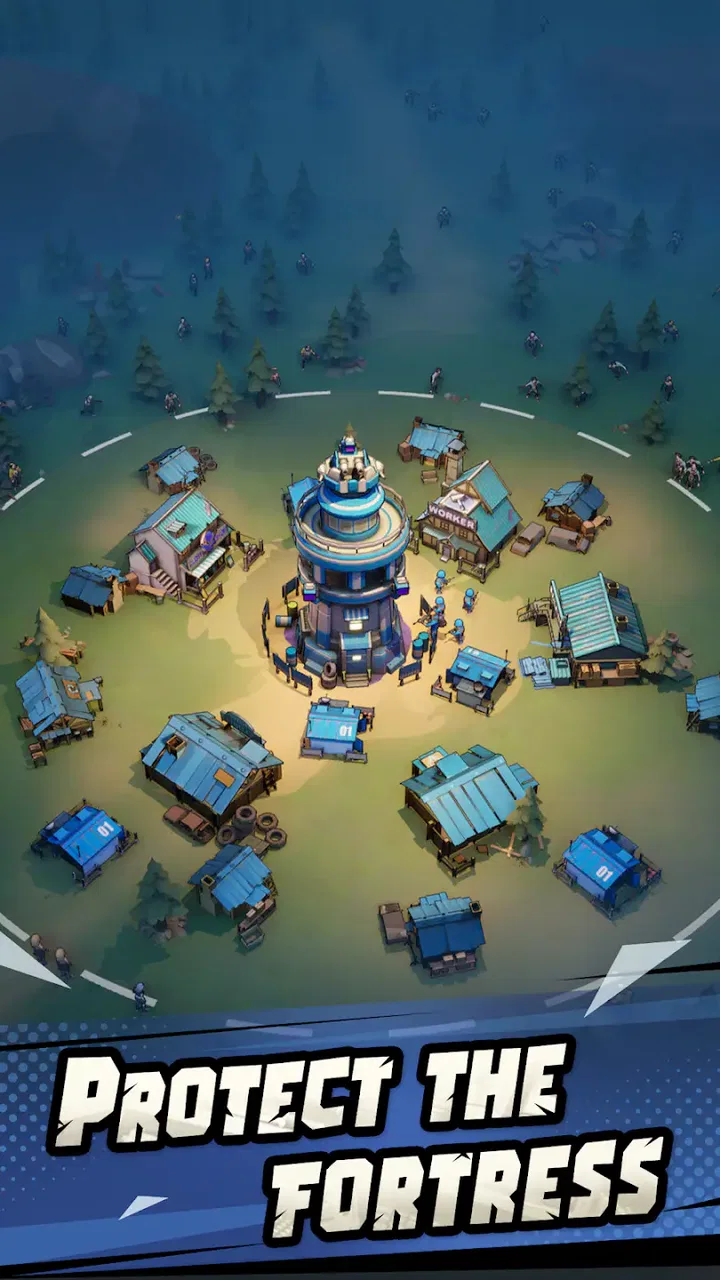
The fort is more than a visual backdrop. It gives the game a clear way to turn survival into prioritization. Every defensive choice implies a trade-off: strengthen what is already working, repair a weak point, or invest in something that may only matter later. The interesting part is not simply making the fort larger. It is deciding which improvement changes your chances most.
My most useful approach was to avoid treating every available upgrade as equally urgent. A broad defensive plan is usually more sensible than chasing the most attractive option in isolation. When a game presents a growing list of improvements, it is easy to spend resources on whatever looks powerful. In a survival setting, however, a balanced base can be more dependable than one impressive feature surrounded by weaknesses.
This is one of the less obvious lessons in the game: building a “super fort” is not necessarily the same as building an efficient fort. A player who focuses only on visible strength may overlook the value of timing. I found it more rewarding to think in stages, using early decisions to create stability and saving later choices for problems that actually appeared during play.
That workflow also helps reduce frustration. Instead of restarting your plan whenever something goes wrong, treat each setback as information. Did you invest too heavily in one direction? Did you leave too little room for recovery? Did you prepare for the threat you expected rather than the threat that actually mattered? Those questions turn a simple mobile loop into a more thoughtful strategy exercise.
Where Last Age: Survival is at its best
The strongest part of the game is its clear identity. It does not need a complicated explanation to communicate what you are doing. You are trying to make a defensible home in a hostile apocalypse, and the decisions naturally connect to that goal. Even a short session has a recognizable purpose.
I also like the way the setting gives ordinary management decisions a little more tension. In a standard construction game, delaying an improvement may feel harmless. Here, the same delay can feel like leaving a door unsecured before a storm. That atmosphere gives more weight to planning, even when the underlying action remains straightforward.
For new strategy players, this clarity is valuable. Some mobile strategy games overwhelm newcomers with layers of currencies, menus, factions, missions, and systems before they understand the basic objective. Last Age: Survival is easier to approach because the fort provides a visible anchor. You can judge progress by asking a simple question: does this make my refuge more prepared?
It is also a reasonable choice for players who prefer a slower pace. The zombie theme may sound frantic, but the strategic appeal comes from control and anticipation. I would recommend it to someone who enjoys checking details and making measured choices, especially if they want a game that can fit around work, study, commuting, or household routines.
Another advantage is that the game’s premise supports experimentation. You can try a defensive approach, notice where it feels weak, and revise your priorities. That is more satisfying than a game where the correct path is obvious from the beginning. Even when a decision does not work perfectly, it can teach you how to read the next situation more carefully.
Practical habits that make the game easier to judge
My first tip is to play several sessions before deciding whether the game is for you. The opening impression of a strategy title can be misleading because early progress often feels generous and uncomplicated. What matters is whether the planning loop remains interesting once you have to choose between competing needs.
Second, keep a mental record of what actually causes trouble. Do not upgrade based only on the most dramatic threat or the most impressive description. If your fort repeatedly struggles in one area, that pattern is more useful than a general feeling that you should make everything stronger. This simple habit turns casual play into a feedback loop.
Third, avoid spending immediately just because an optional purchase is available. The in-app purchase range makes it especially sensible to learn the game’s rhythm first. You may discover that the free experience suits your schedule, or you may decide that a purchase removes a particular annoyance. Either way, waiting lets you judge value based on your own play rather than on impatience.
Fourth, use short sessions deliberately. A quick check is useful when you already know what decision you want to make. A longer session is better when you are comparing several possible priorities. Separating those two kinds of play prevents the game from becoming a repetitive habit with no clear purpose.
Where other strategy games may fit better
Last Age: Survival is not the best choice for every strategy fan. If you want a game centered on direct unit control, tactical battles, or rapid reactions, a traditional battlefield strategy title may give you more satisfying action. Its fort-focused premise is better suited to preparation than to constant command.
It may also disappoint players who want a deep, story-led zombie adventure. The apocalypse setting creates urgency, but the main attraction is the survival-management idea. Someone looking for character relationships, cinematic scenes, or a campaign with a strong narrative arc should compare it with story-driven alternatives instead.
Players who prefer a completely relaxed building game may find the survival framing slightly demanding. The point is not merely to decorate or expand. Defensive decisions carry consequences, and that pressure is part of the appeal. If you want a peaceful construction sandbox with no sense of threat, another category will probably fit better.
There is a similar trade-off for fans of large, established strategy communities. With an average rating of 3.6 and a modest install footprint, this is not presented as the safest choice for someone who wants a proven, heavily populated ecosystem. A larger alternative may offer more mature balancing, more extensive community guidance, or a broader range of content. Last Age: Survival is more attractive if you are comfortable trying a smaller title on its own terms.
The comparison should not be reduced to “new versus popular.” A large alternative may have more systems but also more clutter. Last Age: Survival can be preferable when you want a focused premise and a shorter learning curve. The better choice depends on whether you value depth through complexity or depth through repeated decisions within a narrower framework.
What switching to it really involves
If you are coming from a fast action game, the main adjustment is patience. You may initially feel that the game is asking you to wait or plan when you would rather be doing something immediately. Give it a few sessions and judge whether the anticipation becomes enjoyable. If it never does, the issue is probably a mismatch of genre rather than a problem you can solve with better tactics.
If you are moving from another base-building game, the adjustment is more subtle. You already understand the value of upgrades and preparation, but the zombie setting changes how you interpret risk. You are likely to bring habits from your previous game, such as prioritizing the biggest visible improvement. Here, I found it more useful to reassess the whole fort whenever the pressure changed.
The financial switching cost is low because the game is free to begin. The more important cost is attention. Any strategy game can become a poor fit if it turns into a routine of opening the app without making meaningful choices. Before committing time or money, ask whether each session leaves you with a plan, a lesson, or a new reason to continue.
Version 1.0.2 also sets an expectation that the experience is still relatively early in its life. I would not approach it expecting the breadth of a long-established strategy platform. Instead, I would evaluate the current core: is fort construction engaging, are defensive decisions understandable, and does the apocalypse theme make the planning more enjoyable? Those are the questions that matter most right now.
Who should install it, and who should skip it
I recommend trying Last Age: Survival if you like zombie strategy, defensive planning, and games that can be checked in short bursts. It is especially suitable for a player who enjoys improving a base gradually and learning from weak decisions rather than demanding immediate mastery.
I would also suggest it to someone who wants a less intimidating entry into mobile strategy. The fort gives you a concrete objective, and the survival theme makes the reason behind your choices easy to understand. You do not need to begin as an expert to see what you are trying to protect.
I would skip it if your priority is real-time action, rich storytelling, competitive depth, or a large social ecosystem. I would also be cautious if optional purchases tend to tempt you into spending before you understand a game’s progression. Starting free is the sensible test, particularly because individual purchases can reach $19.99.
For families, the Teen content rating is important. It is not a game I would choose automatically for younger children simply because it is free. The zombie-apocalypse setting is aimed at a more mature audience, so parents should consider whether that theme fits the player.
My recommendation after weighing the trade-offs
My final view is cautiously positive. Last Age: Survival has a focused premise, a useful defensive-planning loop, and enough room for personal decision-making to make the fort feel like more than a decorative feature. Its best moments come when you stop chasing the most obvious improvement and start thinking about resilience, timing, and the consequences of leaving one part of your refuge neglected.
At the same time, I would not describe it as a universal recommendation. The smaller scale, the 3.6 average rating, the early version number, and the optional purchase structure all argue for trying it before investing heavily. The game works best when you approach it as a focused survival strategy experience, not as a replacement for every other zombie or base-building game on mobile.
If I were recommending it to a friend, I would say this: install it when you want a free strategy game built around making a fort more dependable, play without spending at first, and give the planning loop enough time to show itself. The right reason to stay is the satisfaction of making better defensive choices, not simply the promise of fighting zombies. For that particular kind of player, HANX GAMES has created a straightforward apocalypse game with a worthwhile strategic core.
FAQs for Last Age: Survival
01What is the main objective of Last Age: Survival?
In Last Age: Survival, the main objective is to navigate a post-apocalyptic world filled with threats and limited resources. Players must gather supplies, craft tools, build shelters, and fend off enemies to survive. The game emphasizes strategy and resource management while offering an engaging storyline that unfolds as you progress.
02Is Last Age: Survival available for both Android and iOS devices?
Yes, Last Age: Survival is accessible on both Android and iOS platforms. Players can download the game from the Google Play Store or the Apple App Store, ensuring a wide availability for mobile users. The game is optimized for various devices, offering smooth performance and an immersive experience across different operating systems.
03Does Last Age: Survival support multiplayer gameplay?
Last Age: Survival features both single-player and multiplayer modes. In multiplayer, players can team up with friends or other online users to tackle challenges together. This mode allows for cooperative gameplay, enhancing the survival experience through shared strategies and team-based tasks, making it a popular choice for social gamers.
04Are there in-app purchases in Last Age: Survival?
Yes, Last Age: Survival includes in-app purchases that enhance gameplay. Players can buy various items, such as resources, weapons, and cosmetic upgrades. While these purchases can accelerate progress, the game is designed to be enjoyable without them, maintaining a fair balance for both paying and non-paying users.
05What age rating is appropriate for Last Age: Survival?
Last Age: Survival is rated for players aged 12 and up. The game contains themes of survival, mild violence, and strategic planning, making it suitable for teenagers and adults. Parents are encouraged to consider the content and themes to ensure they align with their child's maturity level before allowing them to play.
Pros
- Engaging post-apocalyptic storyline.
- Diverse character customization options.
- Challenging survival mechanics.
- Immersive graphics and sound design.
- Regular updates with new content.
Cons
- Requires constant internet connection.
- In-app purchases can be pricey.
- High battery consumption.
- Steep learning curve for new players.
- Occasional connectivity issues.

Last Age: Survival
Gallery